11 under-the-radar national park lodges your family doesn’t know about (yet)
Every family planning a national park trip hits the same wall: where do you actually stay? Camping is great in theory and exhausting in practice (especially with kids under 8). Gateway-town hotels work but feel disconnected from the park. And the famous in-park lodges—Old Faithful Inn, El Tovar, the Ahwahnee—book up a year in advance and cost a small fortune.
But what most folks don’t realize is that there’s a whole tier of national park lodges for families that fly under the radar. These historic properties are often inside or adjacent to parks, with real character and real beds, at prices that won’t make you flinch (as hard). Some are genuinely hidden—accessible only by boat or surrounded by temperate rainforest. Others are hiding in plain sight, overshadowed by a more famous neighbor 100 yards away.
These are the 12 we think families should know about. They’re not the most Instagrammed or the most written-about. They’re just really, really good places to stay when you’re exploring America’s best parks with your kids. (Prices are approximate and vary by season. Book early—always.)
1. Tenaya at Yosemite
Park: Yosemite National Park (2 miles from south entrance)
Location: Fish Camp, California
Built/Opened: Modern resort, renovated and expanded over the years
Family-friendly highlights: Seasonal kids’ programs, nature scavenger hunts, s’mores by the fire pit, outdoor pool with mountain views
Rooms: Cabins, cottages, lodge-style rooms and suites with balconies; some with kitchenettes
Dining: On-site restaurants sourcing from local farms; BBQ pit in summer, café for grab-and-go
Approximate price: From $250/night (varies significantly by season; summer books fast)
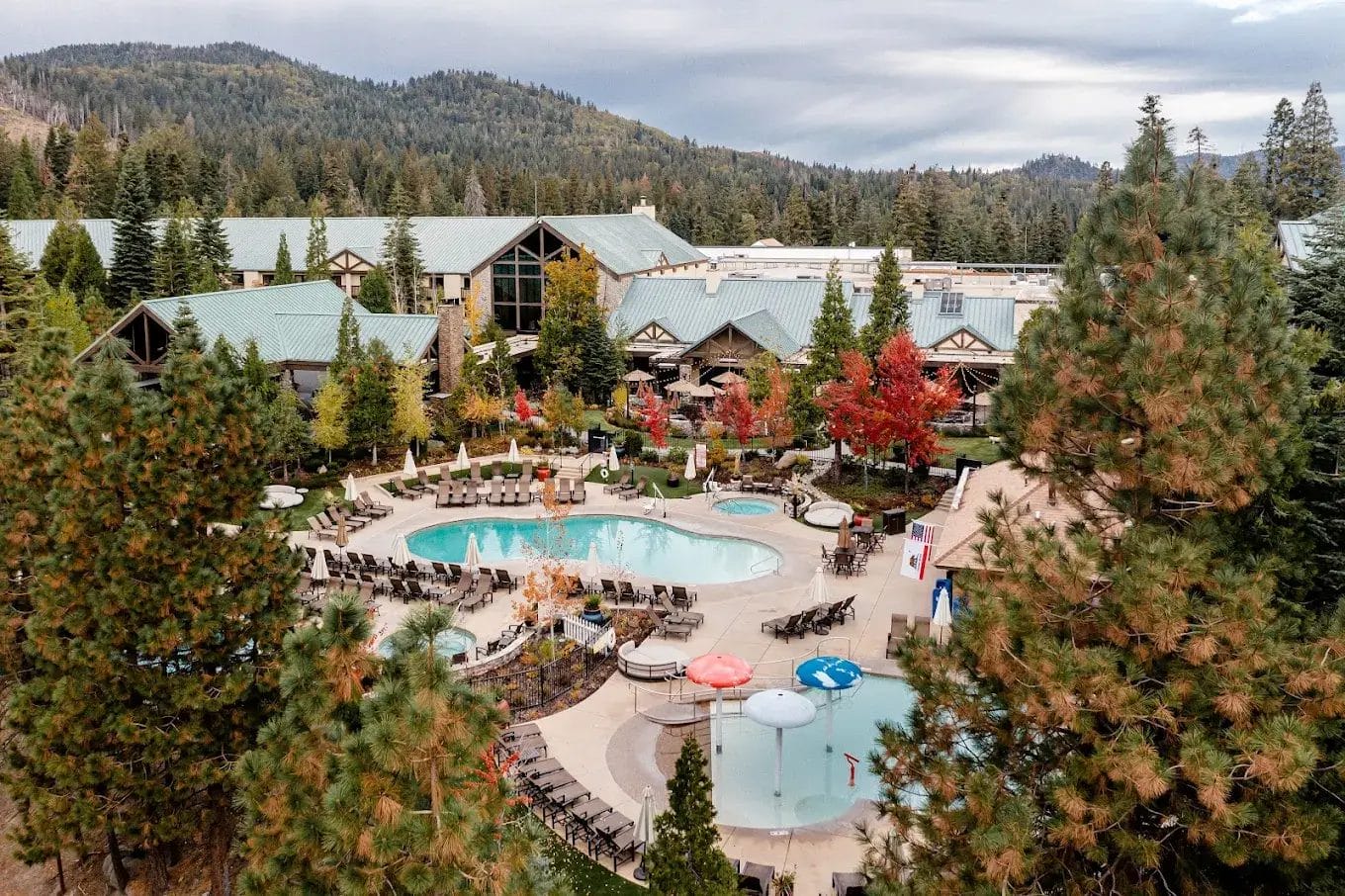
You’re not technically inside Yosemite, but you’re two miles from the south entrance, which means you get all the access with none of the “sleeping on a sold-out campground” energy. The resort sits on 48 acres of Sierra Nevada forest and takes full advantage of all the beauty it has to offer. There’s an outdoor pool overlooking the mountains, ice skating in winter, archery, plenty of mountain (and electric!) biking, and guided stargazing. The kids’ programming runs seasonally and includes nature scavenger hunts, arts and crafts, and s’mores by the fire pit. There’s even a kid-friendly climbing wall to conquer!
What makes Tenaya work for families is the combination of real resort comfort and genuine park proximity. You hike Half Dome (or, more realistically, the Mariposa Grove with a six-year-old), and come back to an actual comfortable bed and a real dinner. That’s the whole pitch, and it’s a good one.
Pro tip: Tenaya is your best bet if you want Yosemite access without the in-park lodging lottery. You can be at Glacier Point or Yosemite Valley within 30 minutes. Book summer stays months in advance.
2. Lake Quinault Lodge
Park: Olympic National Park / Olympic National Forest
Location: Quinault, Washington
Built: 1926
Family-friendly highlights: Indoor heated pool, game room with ping-pong and arcade, lawn games, boat and paddleboard rentals, hiking trails from the back door
Rooms: 91 rooms across six buildings; Lakeside Rooms sleep up to 6
Dining: Roosevelt Dining Room (farm-to-table; named for FDR, who lunched here in 1937)
Approximate price: From $150–$350/night depending on room type and season
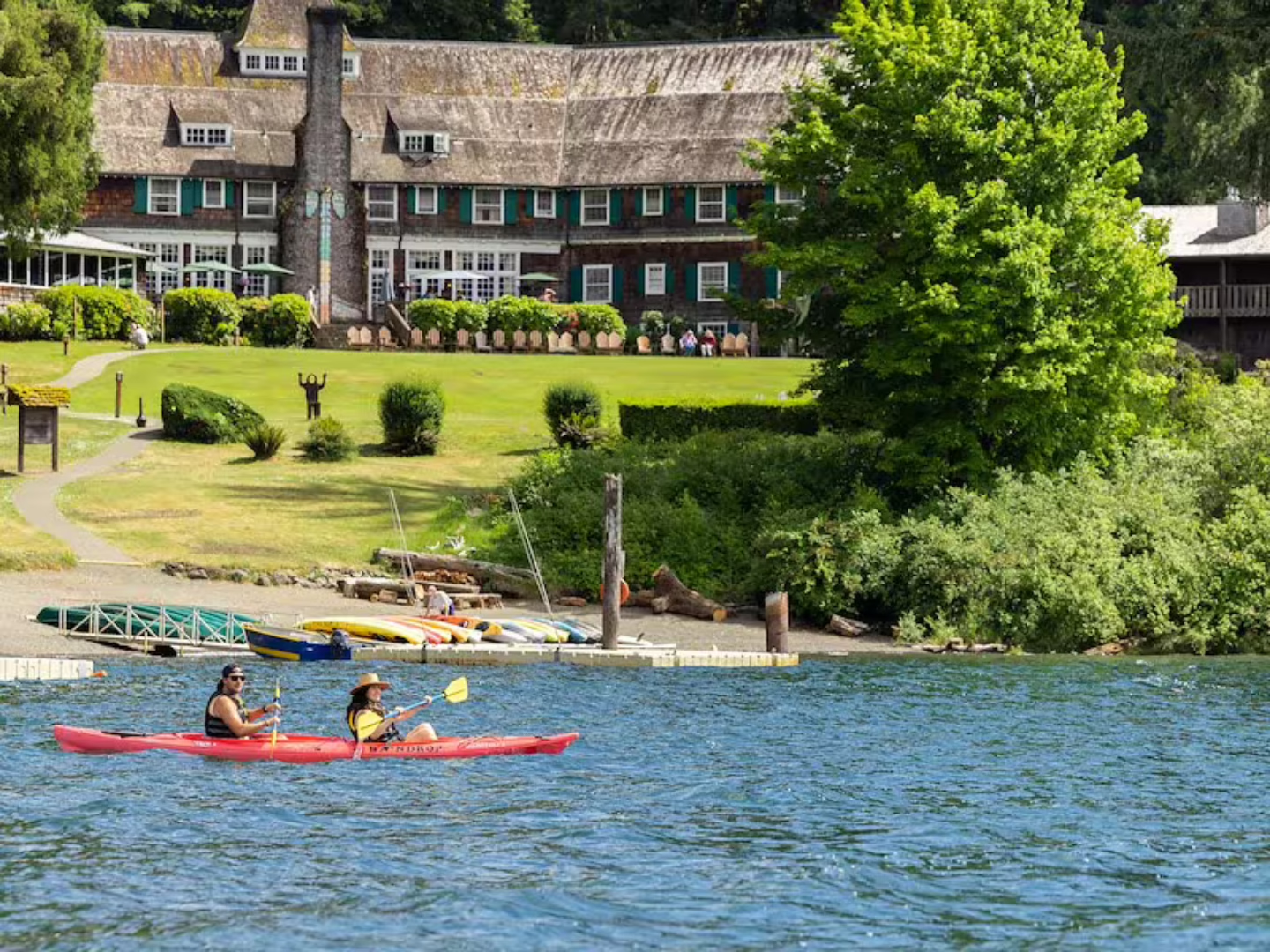
Lake Quinault Lodge is the kind of place where you sink into a leather couch by a massive stone fireplace and think “why doesn’t everyone know about this?” Built in 1926 on the shores of Lake Quinault and surrounded by one of the world’s only temperate rainforests, the lodge feels like a grand old summer camp for the whole family. President Franklin Roosevelt had lunch here in 1937 and was so taken with the area that he created Olympic National Park nine months later. (As the story goes, anyway.)
For families, the setup is ideal. There’s an indoor heated pool (critical in the Pacific Northwest), a game room, canoe and paddleboard rentals on the lake, and hiking trails that start literally across the street. The Quinault Rain Forest Loop Drive puts you in the middle of some of the tallest trees on Earth. To call it magical is quite the understatement–especially if you’re coming from the land of maples or oaks.
Pro tip: Ask the dining room to pack a picnic lunch and make a day of hiking. The Lakeside Rooms sleep up to six and are in a separate building from the main lodge—more space and privacy for families. Spring is a secret great time to visit: fewer crowds, the rainforest is impossibly green, and rates are lower.
3. Skyland Resort
Park: Shenandoah National Park
Location: Mile marker 41.7 on Skyline Drive, Virginia
Established: 1888
Family-friendly highlights: Sunset views over the Shenandoah Valley, trailheads at the doorstep, ranger programs, horseback riding
Rooms: 28 buildings scattered along the ridge; cabins and lodge rooms with valley views
Dining: Pollock Dining Room with valley-view tables
Approximate price: From $150–$300/night

Perched at 3,680 feet along Skyline Drive, the views from your room at Skyland Resort will make you want to set an alarm for sunrise (and actually get up for it). It was established in 1888 which makes it one of the oldest resort properties on this list. The resort itself, which began as a private resort camp, is scattered across 28 buildings along a forested ridge inside Shenandoah National Park. It’s only about an hour from Washington, D.C., which makes it one of the most accessible national park lodges in the country.
The hiking here is phenomenal and family-friendly. Stony Man Trail starts at the resort and is an easy 1.6-mile round trip with big views. For more ambitious families, Whiteoak Canyon (waterfalls!) and Hawksbill Summit (the park’s highest point) are minutes away. Fall foliage season is Skyland’s peak moment—the valley below erupts in color and you have a front-row seat.
Pro tip: Request a valley-view room when booking. The difference between a valley view and a woods view is significant. Also: Skyland is a strong option for families with very young kids because of the proximity to D.C.—you can do a quick two-night trip without a major travel day.
4. The Lodge at Bryce Canyon
Park: Bryce Canyon National Park
Location: Inside the park, on the canyon rim
Built: 1925
Family-friendly highlights: Steps from the canyon rim, ranger programs, horseback riding into the canyon, Junior Ranger activities
Rooms: Historic cabins, lodge suites, and motel-style rooms
Dining: On-site dining room with locally inspired menu
Approximate price: From $175–$350/night

The Lodge at Bryce Canyon is the only hotel inside Bryce Canyon National Park, and it’s been here since 1925. The historic cabins are the best option for families—each has a gas fireplace, a front porch, and the kind of rustic-but-cozy vibe that makes kids feel like they’re on a genuine adventure. Walk out the door and you’re steps from the canyon rim, looking out at one of the most otherworldly landscapes in the American West.
Bryce Canyon is an underrated family park in general. The hoodoos—those tall, skinny rock spires—look like something from another planet, and frankly they’re mesmerizing. (They’re also 144 million years old, a fact which always gets a wide-eyed response.) The Navajo Loop Trail descends right into the canyon and is doable for most school-age kids. Horseback rides into the canyon are available and worth every penny.
Pro tip: The historic cabins book up far in advance for summer. If they’re sold out, the Western Cabins and lodge suites are still inside the park and perfectly comfortable. Bryce Canyon is also a designated Dark Sky Park—nighttime stargazing here is truly a spectacle of nature.
5. Belton Chalet
Park: Glacier National Park (west entrance)
Location: West Glacier, Montana
Built: 1910 (by the Great Northern Railway)
Family-friendly highlights: Steps from the park entrance, on-site dining, wraparound porch, proximity to rafting and lake activities
Rooms: Hotel rooms in the main building plus private cottages
Dining: Belton Grill and Tap Room
Approximate price: From $175–$350/night
Everyone going to Glacier fights for rooms at the famous in-park lodges—Lake McDonald, Many Glacier—and sleeps on the Belton Chalet, which is tucked just outside the west entrance and has been welcoming guests since 1910. (Also, the same year the park was created.) One of the first iconic lodges built by the Great Northern Railway, the chalet has the historic charm of the in-park lodges at a fraction of the booking frenzy. Conveniently, Amtrak still makes stops here twice daily. It’s also reportedly haunted by a friendly ghost named “Belton Bob,” which your kids will either love or have strong opinions about. (So inform them of this fact only if you’re prepared to deal with the consequences.) It is worth noting that the lodge is situated on a main road with a fair amount of traffic, but the surrounding woods make it feel a bit more secluded.
The location is perfect as a base camp for Glacier. You’re minutes from Going-to-the-Sun Road, Lake McDonald, and the park’s western trailheads. The wraparound porch with mountain views is where you’ll end every evening.
Pro tip: The private cottages are the best family option—more space and privacy than the main building. Belton Chalet is also a great fallback if the in-park lodges are sold out, which they usually are. Book for late June through September for the best weather and full Going-to-the-Sun Road access.
6. Kennicott Glacier Lodge
Park: Wrangell-St. Elias National Park & Preserve (the largest national park in the U.S.)
Location: Kennicott, Alaska
Family-friendly highlights: Glacier hiking, ghost town exploration, wildlife viewing, frontier-adventure vibes
Rooms: Lodge rooms with glacier views; shared and private bathrooms available
Dining: On-site restaurant with Alaskan specialties
Approximate price: From $250–$400/night
Season: Late May through mid-September

This one is for families who want a genuine frontier adventure. The family owned and operated Kennicott Glacier Lodge is based in Alaska’s largest ghost town (it’s actually the remains of a historic copper mining operation) and inside the largest national park in the United States. At six times the size of Yellowstone, Wrangell-St. Elias it’s absolutely massive, and the lodge puts you at the edge of a glacier with mountains stretching in every direction. The main lodge boasts a 190-foot long porch with stunning panoramic views and just 23 rooms. The adjacent South Wing provides another 20. It’s quaint, picturesque and “quintessentially Alaskan.”
The 3-mile round-trip Glacier Trail to Root Glacier is doable with older kids and genuinely thrilling. I mean, you walk onto an actual glacier. How cool is that? The ghost town itself is a National Historic Landmark and fascinating for kids who like history, mining, or things that are slightly spooky. Be advised, however, that this is not a polished resort experience. It’s remote, it’s rugged, and that’s exactly the point.
Pro tip: Getting to Kennicott requires a 60-mile drive on a gravel road from Chitina. (Yes, really.) It’s an adventure in itself, but plan accordingly—this is not a quick detour. Best for families with kids 8+ who are up for a real wilderness experience. The long Alaskan summer daylight means you can hike until 10 PM.
7. Bright Angel Lodge
Park: Grand Canyon National Park (South Rim)
Location: Grand Canyon Village, Arizona
Built: 1935 (designed by Mary Colter)
Family-friendly highlights: On the canyon rim, mule rides, ranger programs, Bright Angel Trail access, Junior Ranger activities
Rooms: Lodge rooms, historic cabins (some with canyon views and fireplaces)
Dining: Multiple options on the South Rim within walking distance
Approximate price: From $125–$350/night

Everyone scrambles for reservations at El Tovar, the famous grand hotel on the Grand Canyon’s South Rim. Meanwhile, Bright Angel Lodge sits right next door—literally on the rim—designed by legendary architect Mary Colter, and is easier to book, more affordable, and honestly just as well-located. Some of the rim-view cabins have fireplaces and feel like your own private outpost on the edge of the canyon.
The lodge is steps from the Bright Angel Trailhead, which is the most popular family-friendly trail into the canyon. Mule rides, ranger programs, and the park shuttle system are all right here. For families who want to stay inside the park without paying El Tovar prices or fighting for a reservation 13 months out, Bright Angel is the move.
Pro tip: The Buckey O’Neill Cabin is the most coveted room on the property—a freestanding cabin from the 1890s right on the canyon rim. It books instantly, but it’s worth checking for cancellations. For families, the standard historic cabins are charming and more readily available.
8. The Lodge at Mammoth Cave
Park: Mammoth Cave National Park
Location: Mammoth Cave, Kentucky
Family-friendly highlights: Cave tours depart from the visitor center steps away, above-ground hiking and kayaking, Junior Ranger program
Rooms: Lodge rooms and woodland cottages
Dining: On-site dining room and café
Approximate price: From $100–$200/night
Mammoth Cave is the world’s longest known cave system with over 420 miles mapped and counting. Conveniently located, The Lodge at Mammoth Cave puts you within walking distance of the cave tours that are the whole reason to visit. This might be the most affordable lodge on this entire list, and for families it’s an absolute gem. Yes, it’s simple and some of the rooms are on the dated side, but the family cabins which opened just last summer are spacious and stylish.
The cave tours range from easy, flat walks (great for younger kids) to more adventurous crawling-and-climbing routes for older kids and teens. Above ground, there’s hiking through the hardwood forest, kayaking on the Green River, and one of the best Junior Ranger programs in the park system. Kentucky in general is an underrated family destination, and Mammoth Cave is a big reason why.
Pro tip: Book your cave tour reservations separately from the lodge—they’re through Recreation.gov and the popular tours (especially the Domes and Dripstones and the self-guided tour) sell out in summer. The woodland cottages are the best family option at the lodge—more space and a front porch for evening hang time.
9. Volcano House
Park: Hawai’i Volcanoes National Park
Location: Volcano, Big Island of Hawai’i
Built: Original structure dates to 1846; current building from 1941
Family-friendly highlights: Views of Kīlauea caldera from the hotel, crater rim trails from the door, Thurston Lava Tube, steam vents, ranger programs
Rooms: 33 rooms; some with crater views
Dining: The Rim restaurant overlooking the caldera; Uncle George’s Lounge
Approximate price: From $250–$450/night

There is no other hotel in the national park system where you can eat dinner while looking out at an active volcano. None. Volcano House sits right on the rim of Kīlauea’s caldera inside Hawai’i Volcanoes National Park, and the views from the crater-view rooms are genuinely surreal—especially at night, when the glow from the volcanic activity is visible.
For kids who are into science, geology, or anything remotely dramatic, this is the ultimate national park stay. The Thurston Lava Tube is a short drive away (walking through a tunnel formed by flowing lava is as cool as it sounds), and the Crater Rim Trail starts right at the hotel. The whole park has an otherworldly quality that feels nothing like any other park in the system.
Pro tip: Request a crater-view room—the difference between a crater view and a forest view is the difference between “that was nice” and “that was the most amazing hotel room of my life.” The Big Island is large, so plan to spend at least two nights to properly explore the park.
10. Ross Lake Resort
Park: North Cascades National Park Complex (Ross Lake National Recreation Area)
Location: Ross Lake, Washington
Built: Established 1952
Access: By boat, trail, or a combination of truck portage and boat (no direct road access)
Family-friendly highlights: Floating cabins on a mountain lake, kayak and canoe rentals, fishing, hiking trails into the backcountry
Rooms: 15 floating cabins (ranging from one room to three bedrooms)
Dining: No restaurant—cabins have full kitchens. Bring your own food.
Approximate price: From $225–$500/night
Season: Mid-June through late October

Ross Lake Resort is 15 floating cabins on a turquoise mountain lake in the North Cascades—and it might be the most unique lodging in the entire national park system. There’s no road access, instead you get there by a combination of a truck portage and a small boat, which is exactly as adventurous as it sounds. Once you arrive, you’re living on the water, surrounded by mountains and forest, in a cabin with a full kitchen.
This is not a resort in the traditional sense. There’s no restaurant, no front desk, no concierge. You bring your own food, you cook in your cabin, and you spend your days kayaking, fishing, and hiking into some of the most pristine wilderness in the lower 48. For self-sufficient families who want a genuine off-grid experience without sleeping on the ground, Ross Lake is unmatched.
Pro tip: Reservations are accepted starting in the fall for the following season, and the resort books up almost immediately. If you want a cabin, set a calendar reminder and be ready to book the day reservations open. The larger cabins (two and three bedroom) are ideal for families or multi-family trips.
11. The Inn at Death Valley
Park: Death Valley National Park
Location: Furnace Creek, California
Built: 1927 (formerly the Furnace Creek Inn)
Family-friendly highlights: Spring-fed pool, stargazing deck, palm garden, desert hikes, Badwater Basin and Zabriskie Point nearby
Rooms: Spacious rooms, casitas, and pool bungalows; recently renovated
Dining: The Inn Dining Room (upscale Southwest); café options nearby
Approximate price: From $300–$700/night (peak season is fall through spring)
Granted, Death Valley sounds like a terrible place to take your family, but don’t get too hung up on the name. It’s actually one of the most fascinating parks in the system, and The Inn at Death Valley is the reason you can enjoy it in comfort. Built in 1927 and recently renovated, the inn has a spring-fed swimming pool that feels miraculous in the desert, a palm garden, an observation deck built for stargazing, and some of the most dramatic landscape views you’ll find at any park lodge.
For kids, Death Valley is a science lesson come to life: salt flats, sand dunes, volcanic craters, the lowest point in North America (Badwater Basin, at 282 feet below sea level), and a night sky so dark that the Milky Way looks painted on. The trick is timing—visit in late fall, winter, or early spring when temperatures are actually pleasant. Summer is genuinely dangerous.
Pro tip: Do NOT visit in summer. Seriously. Temperatures above 120°F are no joke. The sweet spot is October through March, when highs are in the 60s–80s and the park is gorgeous. The casitas and pool bungalows are the best family options—more space and privacy than the standard rooms. Stargazing from the deck is a mandatory evening activity.
How to book a national park lodge without losing your mind
Book early, but understand the timeline
Most national park lodges open reservations 11–13 months in advance. The famous lodges (Old Faithful, El Tovar) sell out within hours. The lodges on this list are generally easier to book, but summer dates at popular properties like Bryce Canyon and Ross Lake still go fast. Set calendar reminders for when reservations open and be ready to book that day. Winter and shoulder seasons are much more forgiving.
Know who operates the lodge
National park lodges are operated by concessionaires, not the National Park Service itself. That means you’re typically booking through the concessionaire’s website (like Aramark, Xanterra, or Delaware North), not through NPS.gov or Recreation.gov. Cave tours, campgrounds, and some activities are booked separately through Recreation.gov. It’s a two-system situation that catches a lot of families off guard.
Consider shoulder seasons
Spring and fall are the secret weapons of national park travel. Rates are lower, crowds thin dramatically, and in many parks the scenery is arguably better—wildflowers in spring, foliage in fall, cooler temperatures in desert parks. Shenandoah in October, Death Valley in November, and Bryce Canyon in May are all extraordinary.
Don’t overlook the “just outside the park” lodges
Several lodges on this list—Tenaya, Belton Chalet, Kennicott—are technically outside the park boundary but functionally just as close (or closer) to the best trailheads and attractions. “Inside the park” doesn’t always mean “closer to the good stuff.” Check actual driving distances to the specific areas you want to visit before assuming an in-park lodge is the better option.
Have a backup plan
If your first-choice lodge is sold out, check back regularly for cancellations—they happen, especially as trip dates approach. Many concessionaires don’t charge cancellation fees until 48–72 hours before check-in, so people do cancel. You can also look at nearby Forest Service cabins, which are often rustic but affordable and surprisingly well-located.
The national parks belong to everyone, and staying inside (or right next to) them shouldn’t require a trust fund or a 13-month planning horizon. These 12 lodges prove there’s a whole world of park accommodations between “camping in the rain” and “$800-a-night landmark hotel.” A fireplace cabin on the rim of Bryce Canyon. A floating cabin on a mountain lake. A rainforest lodge where a president once ate lunch. These are the places that turn a national park trip from a day visit into a real family vacation—the kind where you wake up already there, step outside, and the park is your backyard.
source https://www.mother.ly/travel/national-park-lodges-for-families/


Comments
Post a Comment