Goldie Hawn Shares Her Advice For Raising Kind, Emotionally Resilient Kids
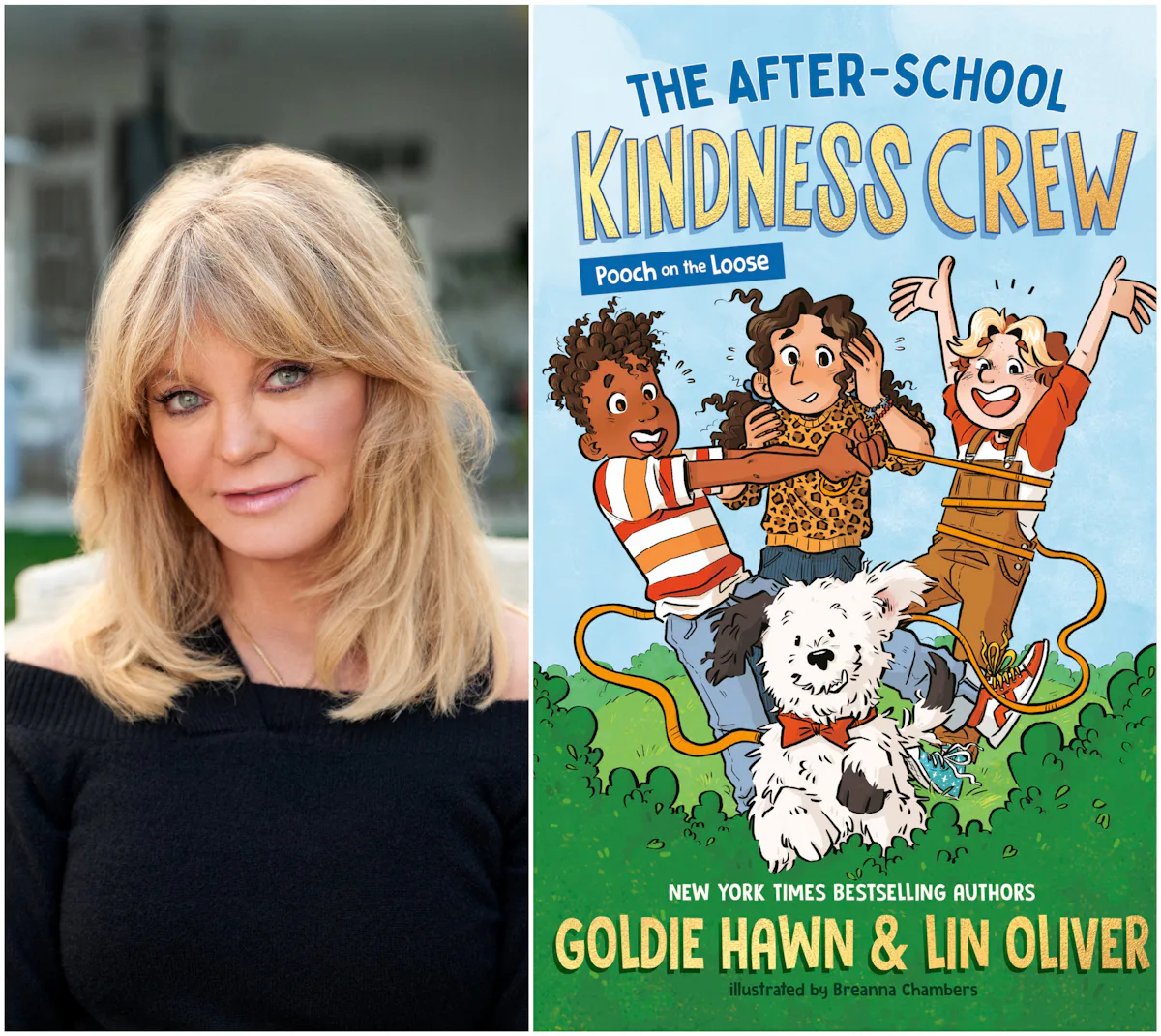
Goldie Hawn is one of those rare celebrities who is exactly how you'd imagine her: warm and kind, like sunshine incarnate. She feels like everyone's mom. But what's equally as gravitational about Hawn is how deeply knowledgeable and passionate she is about the well-being of children.
For more than two decades — in between movies, and raising her own kids, and spending time with her grandkids, and being one half of Hollywood's most beloved couple — Hawn has dedicated her time and energy to children's mental health through MindUP, the evidence-based program she founded to help kids better understand their emotions.
Now, she's bringing those same ideas to our kids through The After-School Kindness Crew: Pooch on the Loose, a humorous and heartfelt middle-grade book series co-written with Lin Oliver. The story follows a group of fourth graders as they navigate everyday challenges with kindness, curiosity, and mindfulness… complete with "brain breaks" woven throughout the book to help kids pause and reset alongside the characters.
When Scary Mommy caught up with Hawn, she discussed emotional resilience not as some trendy parenting buzzword, but as something profoundly human — a thing kids need and deserve just as much as food, sleep, and love. As the conversation moved off page, she opened up about raising empathetic kids, why parents need "brain breaks" too, and her hope that the next generation gets to experience more freedom, more connection, and more joy than the increasingly anxious world around them often allows.
In other words, more opportunities to simply be kids.
Scary Mommy: The book emphasizes kindness and curiosity as components of empathy. Why is that so important?
GH: It is. It really is. And you can teach empathy because the brain has plasticity and we actually, through experience, learn and have empathy. I think some children are born with more than others in terms of empathy ... I have a grandson who's extremely empathetic, and he's young — he's 5. Then there are other children who don't seem to have it, but you can develop it.
I think a lot of it has to do with the way our children are raised, because I know the way my grandchildren are raised, they all have empathy, and it has to do with how the parents are and how we show them kindness, and they need to feel that. So it's important for parents to know that. What you give your child will actually come back to you.
SM: Oh, absolutely. That's like my primary rule with my kids — be kind to others.
GH: Yep, yep, yep … I would get very strong if the children were unkind. Mistakes, accidents, experimenting — all this stuff didn't bother me; we just learned from them. But not when you're unkind to someone, and not when you don't look them in the eye when you say hello. There are a lot of things that I drilled into them because this is who we are. We're human beings, and we have to have this connection to other people in a good way.
SM: How does that translate in the book?
GH: The stories and the experiences the kids will be feeling when they read the book are really so healthy. I mean, Lyle, who's the bully, he's one of those kids that just — you feel kind of bad for them because they feel so little inside, and that was Lyle. But at the end, there was a moment where Lyle actually kind of broke down a little bit and asked them to help him with something. They went through a little confab in their group together, and they just said, "You know what? Let's do it."
They didn't say I forgive … but they did. And that's the showing, not the telling of how the book goes. There's nobody that preaches anything, but the experience they have is what our children will feel and learn from — and it's OK to help someone, even if they're not very nice.
SM: What role does self-kindness play here? Because a lot of kids are really hard on themselves.
GH: Well, being kind to yourself is becoming very aware. The awareness is what we want our children to experience, and that is something that we do in my MindUP program — the idea of self-care and also forgiving yourself … we want our children to forgive themselves, and we explain what's going on with their brains so they know that what's happening is the brain is deciding to get rid of all these connections that it used to have. It really is an interesting time.
Sometimes you do things or slam doors or get mad or whatever, and your emotions are up and down. That's what it is. But I want them to forgive themselves, and this is what you say: Understand where you are, become a witness to where you are — because we have that capability as humans in our brain, it's called metacognition. Let's watch ourselves. And I think for little children, we have to support them by being kind to them. That's the only way you learn.
SM: You’ve worked closely with neuroscientists, psychologists, and educators. Is there anything you wish more parents knew about kids’ brains or emotional development?
GH: I think that parents first need to understand their effect on their children. When we have children, there's no manual, but the one thing that the parent has to do is self-manage, which means it's going to be hard. Kids will try you, but how do you manage your own reactivity? A reactive parent can be very damaging for a child because it scares them.
We don't want to frighten our children — we want to enlighten them. But the parent has to understand how you calm down your brain. We have the brain break, of course, in every book we've done, because it's important that children learn how to do that. That actually reduces the stress, it reduces the reactivity of the amygdala in the emotional brain. That's the center brain. It's a very primitive section of the brain, but it's there to save us.
But it also doesn't understand that sometimes we have impatience, we have anger, we have frustration — we have so many things that ultimately can hijack your higher thinking, and you can't solve problems unless your executive function's online. When you're angry or upset or frustrated or tired or whatever, and you're just focused on other things, you really can't use your brain to decide how you should be.
SM: I love this idea of “brain breaks.”
GH: I remember when my kids were little, I was tired; it was at the peak of my career. Literally I would stop before I got in the house and do what I call a brain break. I've always called it a brain break. It's not meditation. The truth of the matter is that when you focus and breathe — which is what we call what is conscious breathing — it changes your brain, and that's just physiological.
What you want is to quiet your mind and breathe very slowly and get very calm. Then get ready to go back in the house and be a mommy, and just be present for your children. That was what I did because I was tired, but nevertheless, you stop and give yourself that time to just pull it together.
SM: We hear a lot from moms that they’ll sit in their car right before they go inside to create that separation.
GH: Yeah, exactly. Be right there for them because when they see you, it's like their day starts all over again. They're so excited you're home… they're so happy. So you need to match their happiness, and that's hard to do when you're all tired. But you can really reset your brain. It's quite easy; it's just intentional.
SM: If you were going to start your own “kindness crew,” who would be in it?
GH: There are a lot of people who need to just realize how much being kind brings you so much happiness. When you give someone something, your brain responds the same way as when you receive a gift. It's very interesting. It's the mirror neurons — when you watch someone feel happy, you have the same response. So it's a two-way street, and kindness actually helps both of you feel better.
SM: What does that look like in practice?
GH: I remember one time I was walking in my neighborhood and getting my exercise, but I saw an older woman walking with a walker. I could see she was really working. And I just had this overwhelming feeling. I didn't know her. I just wanted to hug her. I just wanted to go up there and hug her and tell her how proud I am, and I know how hard she's working. And I did. She looked up at me and said, "Oh, thank you." I said, "I don't go around hugging everybody.” But my point is, I felt so good after that because I followed an instinct, and she did too.
Kindness is very reciprocal, but I don't think enough people are actually experiencing that. So who would be in my club? It would be huge because you want to be like-minded, but you also want people to experience kindness. That's another kind of club — the experience of doing it.
SM: So true. After all your work in this space, what do you hope for this next generation?
GH: I hope that our children are more self-realized — that we can actually open their minds to more curiosity and also to inviting more people into their lives. Not to be fearful. We all know that community and connection are extremely important, and I'd like to see that.
We have issues around, of course, the internet. We've got issues around social media. We have children who are seriously dealing with anxiety and fear and stress and mental health. We really would like to have this feeling that the world is safer, their world can feel safe, and that every child should be able to be free to go outside and play and be a child.
This is where we are today. And no matter what the obstacles are … I do think that we have to go and come into a kinder world because if we don't look at our children as the future of tomorrow, we're not doing what we're supposed to be doing. They are the number one as far as I'm concerned.
This interview has been edited for length and clarity.
source https://www.scarymommy.com/entertainment/goldie-hawn-interview-after-school-kindness-crew-book-mindup


Comments
Post a Comment