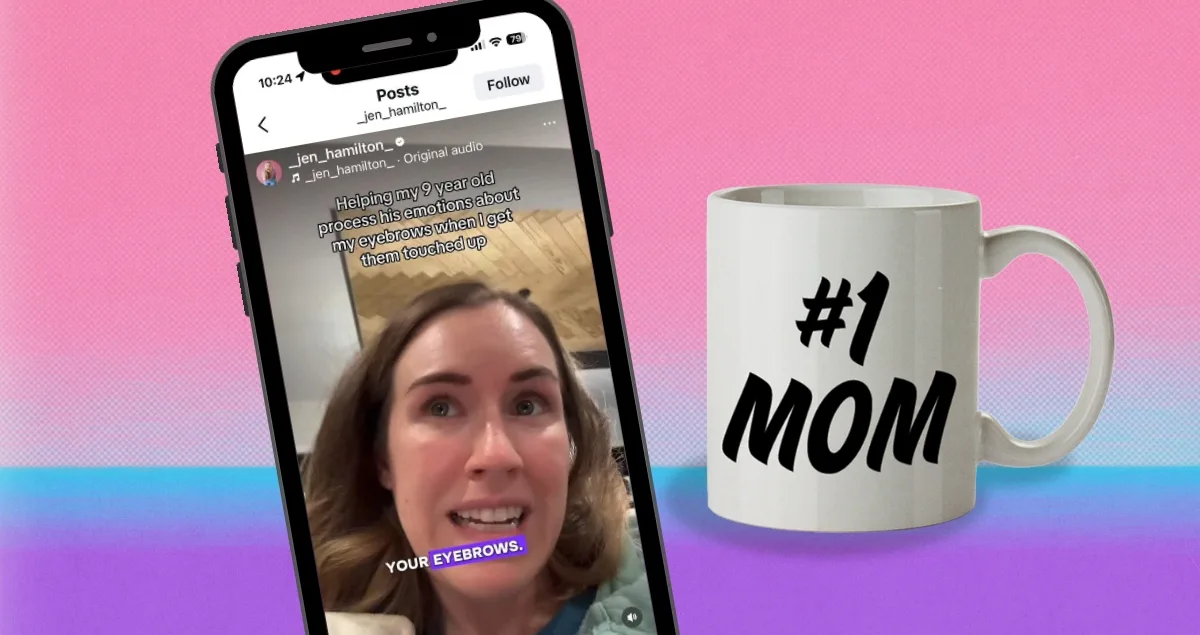
When Jen Hamilton dials into our Zoom, she’s seated in a familiar perch: on her linen-colored sofa, with a digital family photo just visible in the background. If you’re one of the six million people who follow Hamilton on social media, you’d probably recognize it, too. That’s the thing about Jen — you get the sense she’s not “creating content” so much as letting you in on something. She feels like a friend, telling you to come sit; she’ll scooch over a bit.
That familiarity has led to a massive platform, making Hamilton a household name. But she didn’t set out to become the internet’s go-to labor and delivery nurse. In fact, her first TikTok was just her trying to figure out what the “plus” button was.
Now a trusted voice for moms, Hamilton never shies away from saying what needs to be said, whether that’s about maternal care, patient autonomy, or the complicated intersection of faith and politics. Her debut book, Birth Vibes, takes that same approach, blending humor and hard truths into a practical guide for anyone navigating birth (or supporting someone who is).
And I’m happy to report that, yes, Hamilton in real life is exactly what you’d expect. She still works as a nurse on weekends. She still swaddles her chickens, IYKYK. And she has no interest in turning her life into a perfectly optimized content machine.
“I’m here to be a whole person,” she tells me. “If you want to be here, awesome. If you don’t ... that is OK.”
Scary Mommy: When did you realize social media had become something bigger for you?
Jen Hamilton: I think the moment that I realized, Oh, this is different than just being on the internet, is probably whenever I crossed that threshold over into 100k followers, because that was the first time that I had somebody come up to me and say, "I know you from social media." And having that happen at your workplace, patients that you take care of, that was a wild moment for me.
SM: You still work weekends as a nurse. How much does your social presence come up?
JH: With my friends at work, I mean, I'm just the same person. I saw someone comment on someone else's something about me and said that they've worked with me for years and they can tell no difference from before to now. So that meant a lot to me. But at work, I go into a whole lot of different rooms, even if it's not my patient, I go in to help people. And sometimes you'll get this like, "Wait, I know you from somewhere." Sometimes people get it right away, and then other people sometimes are like, "I know I know you somehow." So I probably get recognized three times a shift, depending on what rooms I'm going into, but it happens quite often.
SM: You're a mom and you have this career and you have nursing. Where does filming fit into this puzzle?
JH: It fits in wherever it is natural to fit in. One thing I don't do is make a content calendar or say from this time to this time I'm filming. A video that I did today, I was just sitting on my couch. I had a few minutes before a meeting and just got out my phone. It's only when I feel like it. I never make myself do something that I don't want to do. So there'll be maybe a day or two that I go without posting, or sometimes I'll do seven in one day. It just depends. But I really just fit it in where it's natural to fit in because if I feel like I'm making it a job or making it something that I have to do, then I won't want to do it anymore.
SM: What is the weirdest way that life has changed for you that maybe people wouldn’t expect?
JH: That's a good question. I think it would be in the way that my family interacts with me in the world. It's been the weirdest on my youngest son. We'll be at Disney or some random place, and he is like my security guard. I tell people, “If you come up to me in public, I'm going to be so nice to you. My son will not. He is going to be so mean to you.” And just to expect that. I don't want to make him be nice to people because I want him to think stranger danger. We don't want to tell everybody that we meet out in the world our personal information, which is why while you're standing next to me talking to me, he will come up to me and say, "Don't tell them our address,” like I'm going to bring them home with me or something.
SM: Good looking out, buddy! Well, you’ve had a lot of viral moments. Has anything about going viral ever made you actually feel uncomfortable?
JH: I think it was when people tried to report me to the Board of Nursing, I guess, for reading the Bible and talking about how I think that we should advocate for immigrants and sick people and stuff like that. The Board of Nursing reached out to me and was like, "Hey, we need you to know that you've been reported a lot. We're not investigating, but just so you know." That, of course, makes me uncomfortable in a way that people feel like they can have that kind of control over my life or my livelihood. So that part is not fun, but I'd say that most everything that's happened to me has been positive.
SM: As a white Southern woman, do you feel like people expect you to fit in a certain box politically, spiritually, whatever? And what has it been like stepping outside of those expectations?
JH: I think that being a white Southern woman, there's automatically a box that you get put in. And my favorite thing is when I decided that I wasn't going to try to be everybody's friend, if that makes sense. I'm not going to be everything to everybody. I'm going to tell you what I believe, and you can stay or you cannot stay. Divorcing myself from those expectations that people have of me and just living in a way that I feel good about and that I feel ethically awesome about has freed me from feeling like I have to be a certain way to certain people.
I say a friend to all is a friend to none. If you can't stick up for people when things are wrong, I mean, you have to be bold in the things that you believe sometimes. I'm very glad that I have not tried to be the kind of person who's just like, "Oh, I'm just here to make content. I'm just here to be your dancing monkey." No, I'm here to be a whole person. And if you want to be here, awesome. I would love to be your friend. If you don't want to be, that is OK. There's plenty of other corners of the internet where you can find that.
SM: Why do you think there’s this idea that being Christian and being progressive are at odds with each other?
JH: If you go back in history of when this Republicanism and Christianity — it was like Republicananity — came together, it was all a political movement in order to gain favor with that large group of people in our country. But I think that it still is very pervasive today and still being preached from the pulpit.
There are a lot of one-issue voters, so whoever's going to stop abortion, I think that's where people will always vote. So they will vote against not only their own interests, but also the interests of the people that Jesus called us to love. They will vote against those things as long as that one person follows their views on abortion. I think that it's highly intertwined these days, but I think that it's up to progressive Christians to show people, "Hey, you can be Christian and also be progressive." I believe that Jesus was progressive.
SM: You advocate for patient autonomy, and you’ve also said you don’t have to believe the same thing somebody believes to provide them care. How do you hold these two things together at the bedside?
JH: Absolutely. Number one, I never ask anybody what their beliefs are before I care for them. In nursing school, they did something that I was very grateful for, and that was that they required us as nursing students to go into areas of the community or areas of the hospital where we were in the place of a patient that maybe we don't have a lot in common with. So they would send us to AA meetings, NA meetings, and we had to be there as someone who is going through the throes of addiction. So it allowed me to be able to see people as human beings, and that everyone is trying to do the best they can with the information that they have.
It's easy to be an advocate for somebody if you agree with them about whatever course of treatment or whatever the topic is. But I think being a true advocate means advocating for someone even when you don't agree. And when that is an informed and empowered choice that that person has made, it doesn't matter their background, their race, religion, creed, whatever it might be — I'm going to care for you in the way that I would want to be cared for.
SM: 100%. OK, we have to talk about your book. What made you finally feel like this was the moment to put it all on paper?
JH: It wasn't until people started asking me to that I even thought about it, because I don't even journal. Me writing something was not something that I had in my mind as something that was a goal in my life. I had some publishers that reached out, and I really was feeling like imposter syndrome about it, like, why me? So I wrote a sample just to see what it would feel like, and I had a really good response from that. From there, I kind of got a book deal based on the sample alone.
It was really cathartic to be able to write about the experiences I had been through as a nurse and walked with my patients through. I'm just so honored to have had this happen and had this opportunity.
SM: You’re very candid about the “cascade of interventions.” What’s something that’s become normalized in birth that you think deserves more questioning?
JH: There's a medication that we use called Pitocin, and I feel like it is lifesaving. I want to preface that by saying Pitocin can be life-saving, but it also can be overused or used in a cowboy fashion, where we're just throwing it at people and cranking it when that might not always need to be the case. If somebody's coming in spontaneous labor and their labor is progressing just fine, is there a reason that we have to speed things up? Or if someone's water just broke, could we give them a moment to see what their body's going to do?
It can be used very safely, but also whenever it's used unnecessarily or in a way that is unsafe where we're just cranking it and cranking it, I think that it can cause some not-awesome things.
SM: You’ve said some people in the medical space might not love everything you say. What conversations are you hoping it inspires, even if they’re uncomfortable?
JH: I just hope it inspires people to be able to ask questions and to humanize their care. In the book I talk about the difference between birth plans, where you're checking off actions that you want to either happen or not happen, but birth vibes is more being able to know who you are as a person and what you need that's all the other stuff. How do you need to be communicated with in a way that makes you feel safe and informed? Who are you going to have there with you, and what are they going to do for you? What are the things that bring you comfort? What are the things that annoy you?
When we put all these other things together, you can have a birth experience that, yes, checks off every box, but if you don't have those other things, you can leave that experience feeling unfulfilled, disappointed, guilty, upset, traumatized. On the flip-flop of that, you could have a birth that goes completely off the rails … but if you do have that cocoon of safety of all those other things in place, you can leave that experience — even though it was wild and crazy — feeling fulfilled. It was a positive experience that you were informed, you were empowered, you were respected.
SM: So important. What’s your version of downtime? Do you have time to read or watch shows? I feel like I’ve seen you reference The Pitt.
JH: Yes, I do watch The Pitt. I love the show Company Retreat. Have you seen that one?
SM: So good!
JH: I do have chickens, and so I'll go sit out with them. But yeah, mainly just trying to breathe.
SM: What would be your dream day if you're just planning a day for yourself?
JH: It would be waking up naturally, no alarm clock, going to get brunch at a local place, spending some time outside with my family, being in my chicken coop. It's already cleaned out — someone has come in the nighttime and cleaned it for me. And I think I would end the day having dinner with my whole family, like my mom, my dad, my sister, and everybody.
SM: Oh, that does sound lovely. What is something you hope your kids understand about the work you're doing someday?
JH: That they don't have to do this.
SM: That's a good one.
JH: Yeah. That there's no expectation, honestly, to do anything that they don't want to do. My kids are not really a part of my social media stuff, and that's intentional. I've never kept them from it or anything like that, but I've also never invited them to be in one. I want to protect their sweet little innocent souls, and I think that social media can suck your soul a little bit … so I want to prevent that as much as possible.
SM: Very fair. What is one piece of advice you hear all the time that you secretly or maybe not-so-secretly hate to hear?
JH: Oh, I think it would be the pressure that aunts and cousins and sisters or whatever give to people who are already struggling that they have to breastfeed. I see so many people having such guilt and such defeat as a mom if it's not going well. Feeding your baby is such a personal choice, and however it makes the most sense to you is how you should do it.
The other advice that I tell people about breastfeeding is if it's important to you — if that's something that you really, really are wanting to do — people are going to give you so much advice about your nipples that you never thought would, and only take in the advice that makes sense to you. Because if it doesn't make sense to you or if it causes you stress or anxiety, let it go. Let it go. Let your boobs be your boobs or your babies or whoever's boobs it needs to be, but don't take everybody's opinions and feel like you have to do something about it.
SM: Your time on earth is coming to a close... what is your last meal?
JH: Ooh, this is a good one. OK. It would definitely include crab legs, which I did have last night. Crab legs, a rare steak. We just got a really good crust on it. There would probably be some key lime pie, Graham Central Station Ice Cream — it's like graham cracker; it's delicious. Sides, probably a good corn... No, elote. The Mexican street corn. Yeah, that sounds about right.
This has been edited and condensed for clarity.
source https://www.scarymommy.com/entertainment/that-mom-jen-hamilton-interview
Comments
Post a Comment