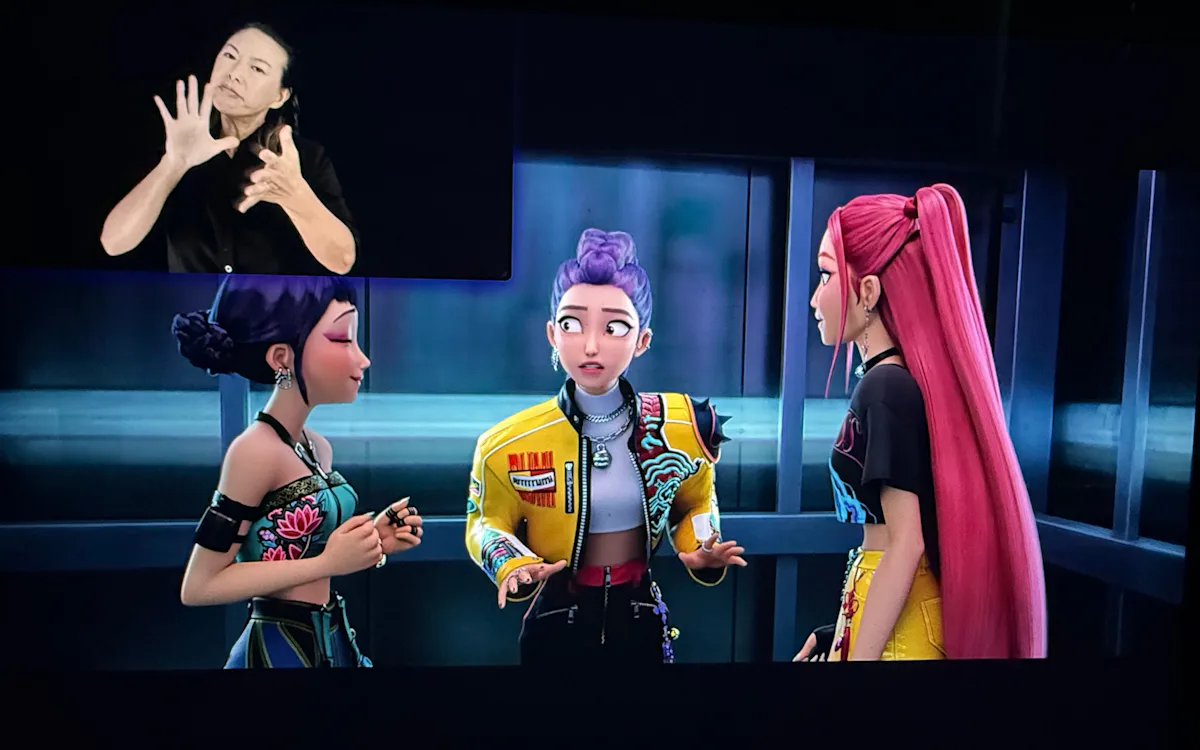
For many families, movie night is an easy win. Everybody piles on the couch or a pallet on the floor, Mom divvies up the popcorn, and you press play. You all watch together, laughing or crying or maybe both as you follow along with the film’s messaging. It’s a simplicity that most of us take for granted. But for families with deaf children, it’s not that easy. Since 90% of deaf kids are born to hearing parents, that has typically meant everyone’s skipping out on movie night… or one parent spends the whole evening interpreting while the rest of the family watches.
You might be thinking, Well, wouldn’t captions solve this? However, many deaf children don’t read fluently until around age 12. A 4-year-old can’t exactly closed-caption their way through CoComelon.
And that’s what makes this news coming out of Netflix so big: The streamer has partnered with SignUp Media to deliver American Sign Language (ASL) interpretation for 73 Kids & Family titles. That’s 200 hours of content across 41 franchises, making it the largest ASL translation effort in entertainment history.
What Families Can Watch
The lineup covers a ton of heavy-rotation shows like CoComelon (you guessed it), as well as Pokémon Horizons, Octonauts, The Magic School Bus Rides Again, and Miraculous: Ladybug & Cat Noir, The Movie. You’ll also gain ASL access to family-friendly films like KPop Demon Hunters, Guillermo del Toro's Oscar-winning Pinocchio, Paddington in Peru, The Sea Beast, The Mitchells vs. the Machines, and more. If you’ve got a tween, there's even Stranger Things: Tales From '85.
You can find a full list of supported titles on SignUp Media's site.
The ASL performances come through SignUp's product, which overlays a signer directly onto the video. This allows families to display, resize, and reposition the interpreter window in whatever way works best for them. You just need to install the free Google Chrome extension, open your Netflix account, then click on the puzzle icon in the top-right corner of your Chrome browser, open the SignUp extension, choose Netflix, and enter the movie or show you want to watch.
Once you find it and press play, you can adjust the box with the interpreter. From there, the content can be mirrored to your screen of choice.
What It Actually Changes At Home
Callie Foster, influencer and advocate for deaf children who's used SignUp with her own family, knows all too well the challenge of movie nights before. Her son, Luca, who has mild-to-moderate hearing loss in both ears, would try to follow along and just couldn’t. “He was trying to decode stuff and was not able to decipher what was going on. It just didn't make sense to him, so he would lose interest," she tells Scary Mommy.
In the early days, she'd stand next to the TV interpreting the words she knew for him. "I could see him looking at me, looking at the TV and then looking at me."
Having an interpreter onscreen changed that instantly. "I quickly realized that it was the gap that was being bridged for him," Foster shares, "because he could then enjoy it, watch it, understand it in real time and not have to sit there and decode it."
For her, the best part has been seeing the shift from Luca asking her questions to help him understand to asking her questions because he understands.
“Instead of him looking at me and saying, 'what happened,' or 'why did that happen,' he understands, and he's telling me, 'did you see that?'" she says. "It's amazing as a parent to watch your child flourish and communicate without having to try so hard."
And, as a mom, she can’t help but think about (and appreciate) what this teaches him long term. “Luca getting to experience the movies he loves in his language, I know, is going to set a precedent in his mind this young: that sign language isn't an accommodation,” Foster says. “It's not something he has to work for. It's something that can be freely given to him, and it's going to give him a sense of belonging."
Why This Is Such A Big-Picture Moment
If we’ve said it once, we’ve said it 1,000 times: Representation matters.
What’s especially cool here is that every performer onscreen in the project is deaf and a native signer. Not to mention, SignUp matched performers to content by lived experience, too: a Cuban deaf performer signs Vivo; an Asian deaf performer signs Wish Dragon; and on and on.
Performers put in three to four hours of prep for every hour on screen, studying characters and pacing the way any actor would.
"When I started SignUp, I believed the deaf community deserved access to entertainment in their language at the same scale everyone else takes for granted," said Mariella Satow, who founded SignUp Media at 17 (she originally funded her first ASL videos by walking dogs). "Hollywood is starting to understand that sign language isn't an accommodation, it's a language, and we're building the infrastructure to deliver it."
Netflix, for its part, is framing ASL as the newest tool in its accessibility features. "With ASL now joining subtitles, Subtitles for the Deaf and Hard of Hearing (SDH), dubbing and Audio Description (AD) as another way members can enjoy our content, we're ensuring our deaf and hard-of-hearing members have more ways to experience the stories they love," Elisa Beniero, senior manager of strategy and innovation at Netflix, said in a release.
There are more than 466 million deaf people worldwide, and until very recently, virtually no sign language interpretation existed in film or TV, even as streamers offered subtitles in dozens of languages. For deaf kids, this partnership means characters like JJ and Rumi and Paddington speak their language now. And for their families, it means everyone finally gets to just... watch the movie.
source https://www.scarymommy.com/entertainment/netflix-signup-media-asl-accessible-kids-shows-movies
Comments
Post a Comment