My son just started middle school. And after spending basically the entire summer worrying about schedules, organization, homework, lockers, supplies, and whether he would remember where the hell he was supposed to go after third period, I’ve discovered something surprising.
I don’t really care about any of that as much as I thought I would.
I mean, obviously I care. Please go to math class. Please bring home your Chromebook. Please, for the love of God, try to keep track of the school supplies we purchased less than a week ago.
But now that he’s actually walking into that building every morning, there’s something else occupying a much bigger piece of my brain:
Is he okay? Not “Did you finish your homework?” okay. Not “How did you do on your science quiz?” okay. Actually okay. Because middle school feels different.
When our kids are little, we have almost embarrassingly intimate access to their lives. Their teacher knows us. We know their friends. They tell us who got in trouble at recess and who cried because someone took the blue marker. They climb into the car after school and somehow manage to recount a seven-minute playground disagreement in enough detail to qualify as sworn testimony.
Then somewhere along the way, things start changing. The answers get shorter. “How was school?” “Fine.” “Who did you eat lunch with?” “People.” “Anything happen today?” “No.”
And suddenly the child whose internal world used to be broadcast directly into my living room has developed privacy settings. Which is developmentally appropriate. And also TERRIFYING. Because middle school is happening at exactly the same time that life gets more complicated. Friendships become more complicated. Bodies start changing. Kids become acutely aware of where they fit — and where they don’t. Academic expectations increase. Social hierarchies emerge. Embarrassment becomes approximately 700% more powerful. And parents become deeply, profoundly uncool.
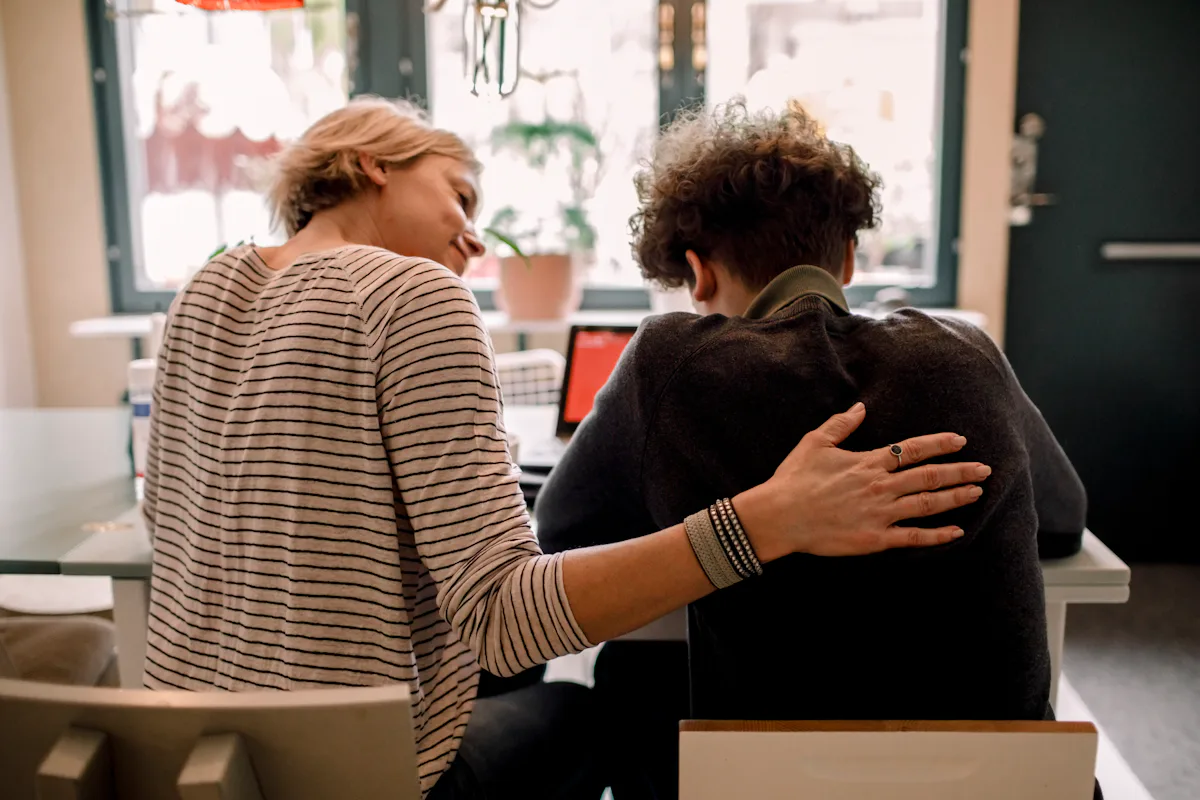
My kid needs more independence now. I know that. I want that for him. But here’s the parenting mindfuck I wasn’t prepared for: Middle school requires me to give him more independence at exactly the same time my anxiety wants me to watch him more closely.
I don’t want to hover. I also don’t want to miss something. I don’t want to interrogate him every afternoon. I also want to know if lunch suddenly feels lonely. I don’t want to turn one crappy Tuesday into a mental-health emergency. But I also know kids don’t always announce when they’re struggling. So I’m trying to learn a different way of paying attention. Less interrogation. More availability. Less “TELL ME WHAT’S WRONG.” More “I’m here whenever you want to talk.”
And that sounds so beautifully emotionally evolved until you’re actually sitting next to a tween who clearly has something on his mind and responds to every question with: “I’m good.” ARE YOU, THOUGH? Because every maternal cell in my body would like to launch a full investigation.
Instead, I’m learning to leave openings. Sometimes that means talking in the car, when eye contact isn’t required. Sometimes it means waiting until bedtime. Sometimes it means asking one question and then shutting the hell up long enough for him to decide whether he wants to answer it. And sometimes it means accepting that he genuinely does not want to talk to me about something. That might be the hardest part. When he was younger, good parenting often meant stepping in. Fixing. Helping. Advocating. Finding the missing thing. Solving the problem.
Now I’m beginning to understand that good parenting sometimes means standing nearby without immediately taking over. I can’t solve every friendship problem. I can’t eliminate anxiety from his life. I can’t make middle school painless. And I probably shouldn’t. He needs opportunities to figure things out. To experience discomfort and discover that he can survive it. To handle small problems before I turn them into big ones. To learn who he is when I’m not standing directly beside him.
My job isn’t disappearing. It’s changing. I’m becoming less of a manager and more of a safe place to land. And I’m trying to remember that mental health isn’t measured by whether my child is happy every day. He’s allowed to have terrible days. He’s allowed to hate a class. He’s allowed to fight with a friend. He’s allowed to come home pissed off, slam his backpack down, eat half the kitchen, and decide that everyone at school is annoying. Sometimes a bad day is just a bad day.
What I’m watching for is the bigger picture. Is he still doing things he enjoys? Is he connecting with people? Is he sleeping? Is he eating? Is he laughing? Does he seem like himself? Are the hard days passing, or are they starting to pile on top of each other? And most importantly: Does he know he can come to me? Because I’m realizing that might be one of the most important things I can give him now. Not constant surveillance. Not a solution to every problem. Not a childhood completely free from anxiety, disappointment, rejection, or struggle. A relationship where he knows there is absolutely nothing he could tell me that would make me stop being on his team.
Middle school is going to ask more of him. Academically, socially, emotionally. And yes, I want him to learn how to manage assignments and remember his schedule and become more independent. I hope he gets good grades. I hope he finds his people. I hope he discovers things he’s good at. But more than any of that, I want him to make it through these strange, awkward, exhilarating, occasionally brutal years knowing that he doesn’t have to navigate them alone.So yes, I’ll check the grade portal. I’ll ask about homework. I’ll remind him about whatever random thing middle school requires tomorrow.
But mostly?
I’ll keep watching him. Not hovering. Not panicking. Just paying attention. Because these days, the report card I care about most isn’t the one the school sends home. It’s the answer to the question I’m learning not to ask quite so loudly: How are you, really?
Danielle Kelly is the host of the ADHD parenting podcast Chaos & Caffeine, which reaches thousands of families each month and was recently named one of the Best Kids With ADHD Podcasts of 2026 by PodRanker.
source https://www.scarymommy.com/parenting/my-kid-just-started-middle-school-im-watching-his-mental-health-more-than-his-grades
Comments
Post a Comment