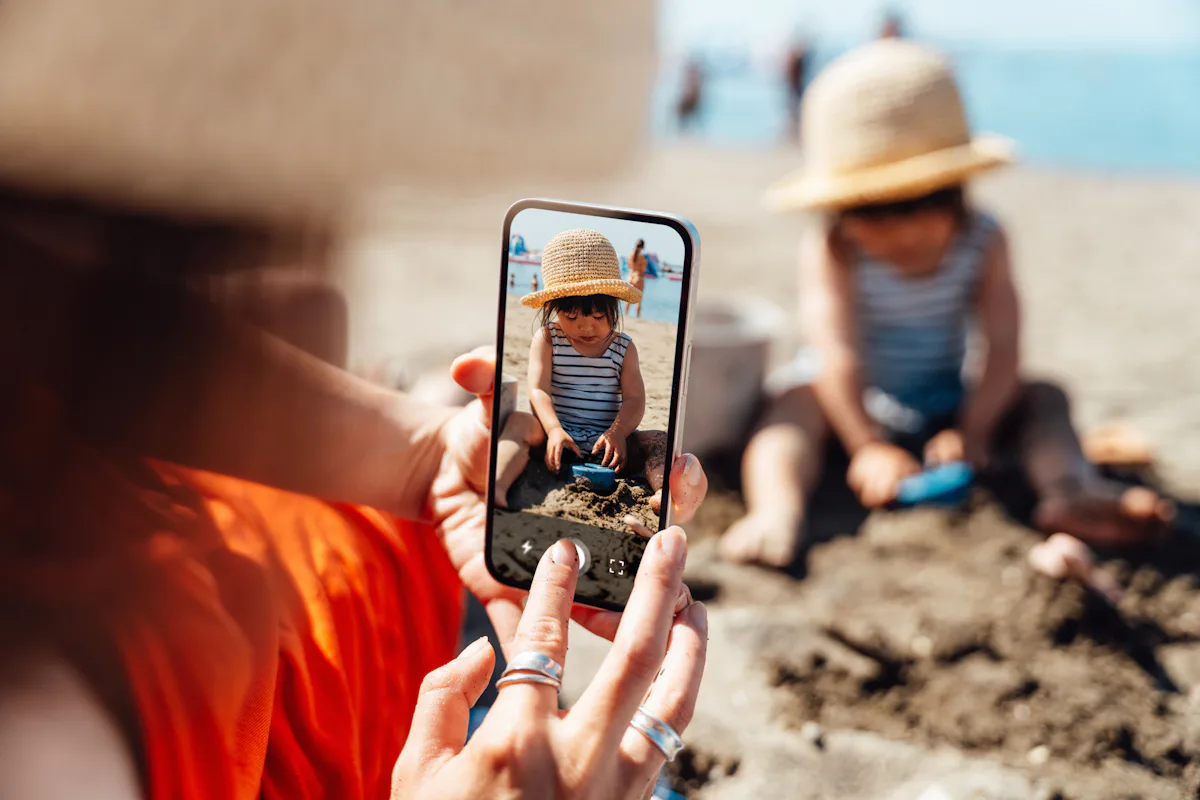
I stopped posting photos of my son on social media almost four years ago, after my husband and I found out one of his college teammates had been charged with possessing and distributing child sexual abuse material. While we had no reason to believe our son’s photos were part of his cache, the fact that he followed my husband on Instagram made us all too aware that our private profiles still didn’t magically make sharing our son’s image online safe. Sometimes the predator isn’t a stranger, and they already follow you.
In the following days and weeks, we went back through our social media profiles, deleting the sun-drenched baby in a bear cub onesie captioned “my little sweet potato” and the family pictures at the pumpkin patch. We texted family members and friends asking them not to share pictures of our son online either. It felt overprotective and uncomfortable to be the only people we knew with this boundary. I imagined my friends swiping through photos after getting together with our kids and being bummed they couldn’t share the cutest of the bunch because my son’s face was in it. “Ugh, you know how she is.” (This was all in my head, by the way. My friends are incredibly supportive.)
The mass deletion also felt a little like erasing the fact that we’d ever had a baby at all, like maybe the happy glow around these moments and my entire matrescence wouldn’t just cease to exist in my digital footprint, but in my own memory. How would anyone know I was a mom at all, specifically a good one? Well, therein lies the motivation to post, for many parents.
Millennials are savvy tech users, and we’re well aware of the precautions we should take online. Most of us are not vlogging our kids’ daily routines to post on YouTube for profit. We’re snapping a pic of our kid’s first lost tooth and posting it on our private accounts, with no identifying information about their whereabouts, last name, or other risky privacy details. We know what to leave out so no one can ascertain where our kids go to school, open a credit card in their name, or guess at their future passwords.
But the magnitude of the risk of sharing at all has skyrocketed in the past year alone, thanks to AI, which can turn a completely innocent school photo of a child into the unthinkable. According to the Internet Watch Foundation, “realistic full-motion AI video content is now commonplace. In 2025, the IWF identified 3,443 AI-generated child sexual abuse videos, an increase of 26,385% compared with the previous year, when just 13 such videos were recorded.” If the AI landscape in 2026 is any indicator, those numbers (and the risk it can happen to our kids) are going to be astronomical by year’s end.
Deepfakes and AI-generated images have also become a common bullying tactic. I can’t imagine trying to survive middle school after some zit-faced twerp generated fake nudes of me based on a completely innocent photo of me from my mom’s Facebook, but it happens now.
Aside from this, there are also less tangible downsides to sharenting, ones that may or may not dissuade a parent from posting. What if your child is embarrassed by the post, now or in the future? What if they don’t want your friends from high school to know they’ve had a stomach bug all week? What if they want to be the ones to tell their grandparents what their Halloween costume was instead of you? Stolen thunder is real when you’re a kid.
We know all of these things, and still we post.
Even after so long not sharing my son online, I still feel the urge to post him. When he earns a medal at soccer, gets an adorable new haircut, snuggles up to the dog on the couch — I want to shout it all from the internet’s rooftops. Look at my kid! Tell me he’s the cutest, the sweetest, the smartest... and by extension, that I’m doing a really good job being his mom.
Research has identified a number of common reasons parents post their kids online: to chronicle life events to remember them later, to “advocate for particular parenting philosophies,” to connect with family members, to gather support from their community, and in some cases, for financial benefit. But “the desire to receive ‘good mother’ approval as an indicator of parenting skills emerges as another sharing motivation,” states a study from all the way back in 2015.
In a 2024 review of 61 studies about sharenting behaviors, researchers identify this need to be viewed as good parents as a main driver behind why we post our kids, even against our better judgment. As modern parenting demands a more intense devotion to every aspect of child-rearing — emotional regulation, developmental milestones, creating core memories — sharing snippets of our lives online has become “both a perpetuator of and a coping mechanism for these pressures,” the authors state. Posting your kid screaming in the backseat for the world to see is, at least in some small part of your brain, about getting your followers to message you in solidarity. “OMG, I’ve been there. You’re doing great, Mama.”
The same article found there is a consistent underestimation of the risks of sharenting among parents, perhaps because we are also weighing the costs of not sharing:
“In relation to children’s privacy, studies suggest that the occurrence of sharenting behavior is not related to parents’ potential knowledge of risks, digital literacy, or competencies... A UK mixed-methods study highlighted a paradox where informed mothers continued to sharent despite privacy concerns, suggesting a complex decision-making process where the psychological need for social interaction may outweigh privacy risks.”
There can be a deep shame for parents who understand all of the risks and still want to post their children (and do). What’s always missing from the conversation about sharenting, and from our own assessments of why we personally do it, is this acknowledgment that we’re doing such intensive parenting with so little support. In a world where your village is spread around the country, sharenting is a way to strengthen connection, to pull your far-flung friends and family into your motherhood journey where you need them. Having someone DM you that you’re killing it, even if it sounds stupid, can be the boon that gets you through bedtime.
Unfortunately, studies also show that while we may feel more connected for sharenting, our children don’t.
A study from 2019 found that when parents shared photos of their children to show their pride, or to archive memories, kids responded more positively. However, when the post was more about “impression management” — trying to shape others’ opinions of their parenting for the better — their children had a more negative view. Overall, “adolescents largely disapproved of sharenting. They mainly considered it as embarrassing and useless,” researchers concluded.
A focus group study from the same year, involving interviews with 46 adolescents ages 12 to 14, found that kids believed “parents should respect a couple of boundaries concerning what types of posts can be shared, how often, and with whom. Moreover, they should ask permission before actually posting about their children.”
Without the external validation of social media, I focus on the actual proof I’m a good mom: when my son says he worried about me all day because I had to get my flu shot, when he spills his guts as we lay in bed and cuddle at night, or when I ask about the rose and thorn of his day and they are “seeing you” and “leaving you,” respectively. These were the only measures of my motherhood that ever really mattered, and they’re the only ones I bother with now.
I may never be rid of the urge to share my son with the world — I’m a pretty big fan of him. But there’s immense comfort in knowing photos of my kid will be very hard to come by for bullies or creeps, and that he has the freedom to define himself as he grows up without having to navigate anyone’s preconceived notions about him because of my posts.
That said, not everyone is as lucky as I am. My family and friends have all been completely on board with our sharenting boundaries. They also all live nearby. We have a village, unlike so many other American parents. I don’t judge or begrudge anyone’s choices around what they do or don’t share of their children online. But if you’ve ever felt an uncomfortable tension around the question of “to post or not to post,” just know you’re nowhere near alone.
source https://www.scarymommy.com/parenting/sharenting-why-parents-post-kids-online
Comments
Post a Comment